
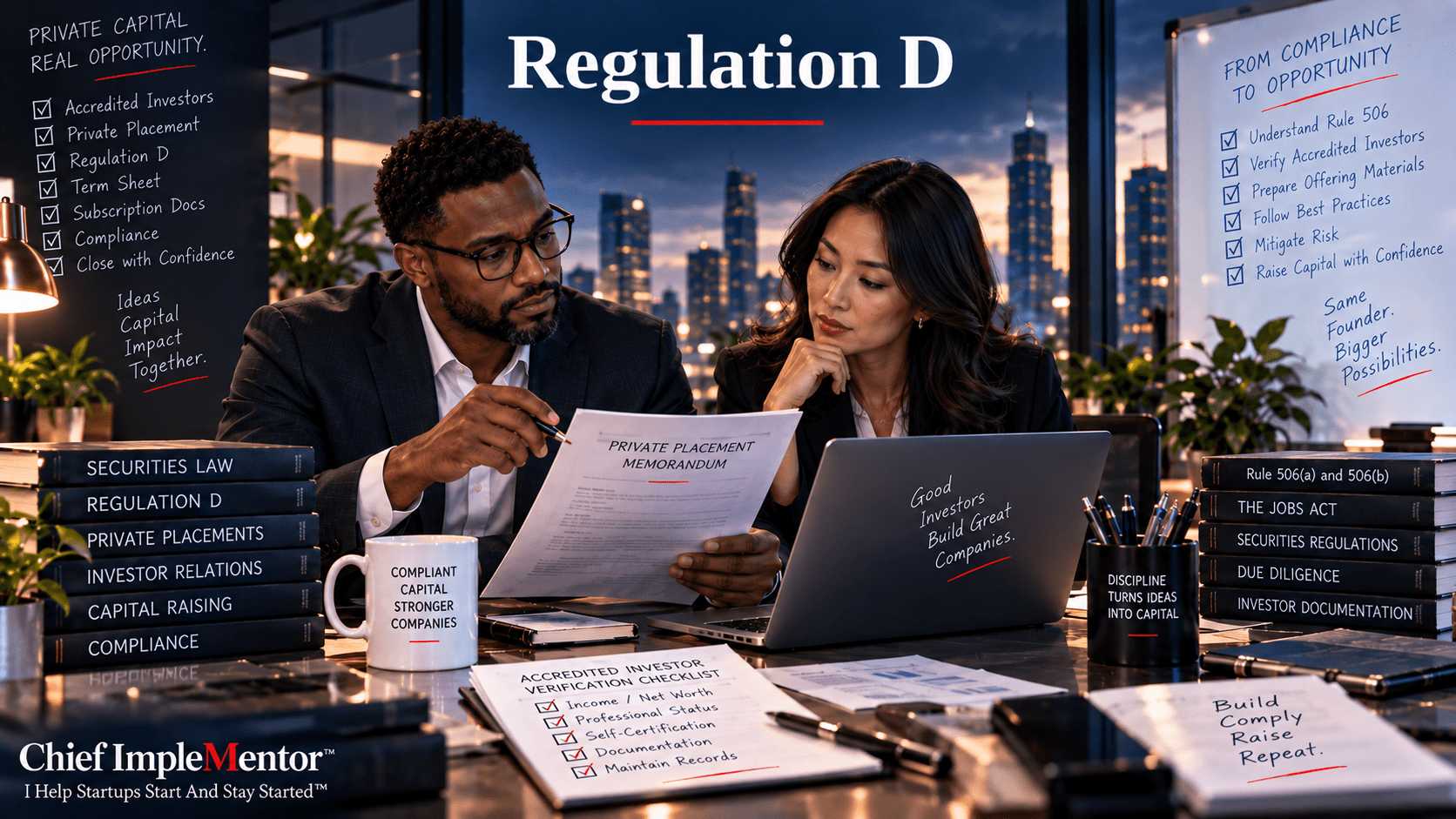
REGULATION D & ACCREDITED INVESTORS
Understand These Rules Before You Start Raising Investor Capital. Regulation D can make an exempt securities offering possible, but it does not make fundraising simple, risk-free or exempt from the rest of the securities laws. The rules that govern your offering need to be understood, properly implemented and reviewed by qualified securities counsel before you begin approaching investors.
ORIGINAL COMPREHENSIVE UPDATE SEPTEMBER 19, 2026 • W CUBED™ INTEGRATION OCTOBER 10, 2026
DEAR FRIEND AND FELLOW ENTREPRENEUR,
Need to raise investor capital for your startup company? Be prepared to walk down a dragon-infested path on your way to your post-funding Point B. Federal securities law begins with a fundamental principle: an offer or sale of securities generally must either be registered or qualify for an exemption from registration.
Regulation D contains several of the exemptions most frequently encountered by startup and privately held companies. However, complying with Regulation D is only part of complying with securities law, and your company’s financing plan must address the practical realities of raising money as well as the legal requirements of offering securities.
I LEARNED THIS BY RAISING THE CAPITAL MYSELF
This subject is not academic to me. I personally completed 44 Regulation D Rule 506 capital raises for 44 of my own companies and limited partnerships, raising $120.1 million in July 2026 dollars from 1,342 investors. I also founded, served as CEO and chaired Goodman Securities, Inc., a direct-participation broker-dealer that was a member of NASD and SIPC. That company operated during my historical fundraising activities and was dissolved in the late 1980s.
When you are personally responsible for raising the money, signing the documents and living with the consequences, securities compliance gets your attention very quickly. That firsthand experience is the foundation of the practical business-side guidance I share with founders today.
A Regulation D Exemption Is Not a Fundraising Action Plan.
Knowing which securities-law exemption may apply to your company is important, but it does not tell you WHO must complete the work, WHAT needs to be produced, WHEN it must be done or how those activities affect your cash runway. My W Cubed™ Startup Company Methodology applies a simple implementation discipline to exactly these kinds of interconnected startup challenges.
W³ = WHO + WHAT + WHEN
The securities attorney analyzes the law, offering structure, required documents and compliance obligations. The founder and management team develop credible business plans, financial projections, operating budgets, capital requirements and implementation schedules. An experienced business mentor challenges important assumptions, exposes missing work and helps the CEO connect decisions that can have second- and third-order consequences.
These are different responsibilities, and they must work together. The free W³ Cubed™ Startup Action Plan includes 204 Action Items, 50 Milestones, nine Action Plans, four Go/No-Go Gates and supporting tools. Action Plan 9 covers fundraising, due diligence and scaling, while earlier Action Plans establish the financial and operating foundation needed to become investor-ready.
REGULATION D IS AN EXEMPTION FROM REGISTRATION — NOT AN EXEMPTION FROM SECURITIES LAW
This distinction is essential. A properly structured Regulation D offering may exempt an issuer from registering the offering under Section 5 of the Securities Act, but it does not eliminate federal anti-fraud provisions, every state-law requirement or the need to assess whether investor solicitation is permitted under the selected exemption.
It also does not automatically legalize paying unregistered finders or success fees, and it does not allow issuers to omit material information or make misleading statements to investors. Your securities counsel must evaluate these issues in the context of your actual proposed offering.
THE THREE CURRENT REGULATION D OFFERING EXEMPTIONS
Rule 504 — Certain eligible issuers may offer and sell up to $10 million of securities during the applicable 12-month period, subject to the rule’s conditions and substantial state-law considerations.
Rule 506(b) — Permits an unlimited dollar amount but prohibits general solicitation and advertising. An unlimited number of accredited investors may purchase, together with no more than 35 qualifying non-accredited purchasers during the applicable 90-calendar-day period.
Rule 506(c) — Permits an unlimited dollar amount and permits general solicitation, but every purchaser must be an accredited investor and the issuer must take reasonable steps to verify accredited-investor status.
RULE 505 IS GONE
If you are reading an article, book, website or old offering manual that discusses Rule 505 as a current Regulation D exemption, you are looking at obsolete information. Rule 505 was repealed effective May 22, 2017, and Section 230.505 is now reserved.
RULE 504 — UP TO $10 MILLION
Current Rule 504 permits qualifying issuers to offer and sell up to $10 million during the applicable 12-month period. The rule is unavailable to certain issuers, including Exchange Act reporting companies, investment companies and certain blank-check or development-stage companies described by the rule. Rule 504 is also subject to bad-actor disqualification provisions.
State securities registration, exemption, disclosure, solicitation and filing requirements can be especially important in a Rule 504 offering. Have securities counsel analyze every state in which securities will be offered or sold, rather than assuming that compliance with a federal exemption resolves every state-law question.
RULE 506(b) — PRIVATE MEANS PRIVATE
Rule 506(b) permits an issuer to raise an unlimited amount of capital, but general solicitation and general advertising are prohibited. The issuer may sell to an unlimited number of accredited investors and, subject to the rule, no more than 35 non-accredited purchasers in any 90-calendar-day period.
Every participating non-accredited purchaser must possess, alone or together with a purchaser representative, sufficient knowledge and experience in financial and business matters to evaluate the merits and risks of the investment, or the issuer must reasonably believe that standard is satisfied immediately before the sale.
If non-accredited investors participate, Rule 502(b) imposes specific disclosure requirements that do not apply in the same way to an accredited-investor-only Rule 506(b) offering. Counsel should review the investor qualifications, required information and solicitation plan before the company begins the offering.
RULE 506(c) — PUBLIC SOLICITATION IS POSSIBLE, BUT VERIFICATION MATTERS
Rule 506(c) changed the private-capital landscape by permitting broad solicitation and general advertising when its conditions are satisfied. Every purchaser must be an accredited investor, and the issuer must also take reasonable steps to verify that status. Merely asking an investor to check a box stating “I am accredited” should not be confused with meeting the separate Rule 506(c) verification requirement.
The rule provides non-exclusive verification methods, and the SEC also recognizes a principles-based, facts-and-circumstances approach. The verification process needs to fit the applicable requirements and should be reviewed with qualified securities counsel.
A GOOD EXAMPLE OF WHY YOU NEED CURRENT INFORMATION
SEC staff guidance concerning Rule 506(c) verification continued evolving in 2025 and 2026. In March 2025, SEC staff confirmed that a sufficiently high minimum cash investment can be a relevant factor in the reasonable-verification analysis when accompanied by appropriate representations and other conditions. In July 2026, the Division issued additional interpretation concerning digital attestations in a tokenized-security context and emphasized retention of adequate verification records.
Staff interpretations and no-action positions are fact-specific. They do not replace the rule or create universal exemptions from verification requirements.
WHAT IS AN ACCREDITED INVESTOR?
The definition is much broader today than the definition that appeared on this website in 2003. Rule 501(a) contains the controlling definition, and the following is a practical summary rather than a substitute for reading the current rule and having counsel apply it to a particular investor.
INDIVIDUALS MAY QUALIFY IN SEVERAL WAYS
- Net Worth: Individual or joint net worth with a spouse or spousal equivalent exceeding $1 million, subject to the rule’s calculation requirements. The primary residence generally is excluded as an asset.
- Income: Individual income exceeding $200,000 in each of the two most recent years, with a reasonable expectation of reaching the same level in the current year.
- Joint Income: Joint income with a spouse or spousal equivalent exceeding $300,000 in each of the two most recent years, with a reasonable expectation of reaching that level in the current year.
- Professional Credentials: Holders in good standing of SEC-designated qualifying professional credentials. Current SEC-designated credentials include Series 7, Series 65 and Series 82 licenses.
- Private-Fund Knowledgeable Employees: Certain knowledgeable employees may qualify with respect to securities offered by the qualifying private fund.
- Issuer Insiders: Directors, executive officers and general partners of the issuer, and certain comparable persons described by Rule 501(a)(4), may qualify.
DO NOT USE THE OLD “$1 MILLION INCLUDING THE HOUSE” TEST
The net-worth test changed after the version formerly reproduced on this website. For the ordinary Rule 501(a)(5) calculation, a natural person’s primary residence generally is not counted as an asset, and the rule contains specific requirements for handling indebtedness secured by the residence.
ENTITIES CAN ALSO BE ACCREDITED INVESTORS
Rule 501(a) includes numerous entity categories. Depending on the facts, these can include:
- Banks and certain financial institutions;
- Registered broker-dealers;
- Certain registered and exempt investment advisers;
- Insurance companies;
- Investment companies and business development companies;
- Certain employee benefit plans;
- Qualifying corporations, partnerships and LLCs with more than $5 million in assets;
- Certain trusts with more than $5 million in assets;
- Entities in which all equity owners are accredited investors;
- Certain other entities owning more than $5 million in investments;
- Qualifying family offices with more than $5 million under management; and
- Qualifying family clients of those family offices.
The precise language and conditions in Rule 501 control, so counsel should examine the actual investor and its applicable category rather than relying on a simplified checklist alone.
The W Cubed™ Regulation D Readiness Checklist
An important lesson from my decades of experience is that knowing a requirement is not the same as ensuring somebody completes it properly and on time. Your securities attorney should determine the actual legal obligations and approve the compliance process, while the management team must provide accurate information, complete its assigned work and communicate material changes to the responsible professionals.
| WHAT Needs To Be Done | WHO Is Accountable | WHEN | Evidence of Completion |
|---|---|---|---|
| Determine whether investor capital is necessary and identify reasonable financing alternatives. | Founder/CEO and Finance Lead | Early capital planning | Written financing decision and supporting financial analysis |
| Determine the true funding requirement using integrated projections and downside cases. | Finance Lead with Founder/CEO | Before setting financing terms | Reviewed cash model, assumptions and capital-need calculation |
| Evaluate potential securities exemptions and select a lawful offering structure. | Qualified Securities Counsel | Before offers or investor solicitation | Counsel-approved offering strategy |
| Determine permitted solicitation methods and investor eligibility requirements. | Securities Counsel with Funding Lead | Before any investor communications | Approved outreach and investor-qualification procedures |
| Review persons who may trigger bad-actor disqualification or broker-dealer issues. | Securities Counsel with Founder/CEO | Before the offering and as circumstances change | Appropriate legal diligence records |
| Prepare required disclosure, investor subscription and supporting documents. | Securities Counsel with Finance Lead | Before the documents are used | Approved, version-controlled materials |
| Confirm financial numbers and statements agree across investor-facing materials. | Finance Lead with Founder/CEO | Before release and after material changes | Document-reconciliation review |
| Complete required federal and state notices, filings and amendments. | Securities Counsel and Designated Filing Owner | According to applicable filing deadlines | Filed notices, receipts and compliance records |
| Maintain investor qualification and verification records where required. | Authorized Compliance Owner | Before sales and through the required retention period | Appropriate secure records |
| Review material changes and ongoing investor communications. | Founder/CEO with Securities Counsel | Throughout the offering | Current documents and review history |
This is a management planning example, not a comprehensive legal checklist. Responsibilities and deadlines depend on the actual financing transaction, and counsel should determine and approve the legal tasks, parties and timing.
W³ Cubed™ Startup Action Plan provides the larger 204-Action-Item execution framework. Its fundraising Action Plan and earlier financial Action Plans provide the baseline into which a company-specific legal and fundraising checklist should fit.
DOES REGULATION D REQUIRE A PRIVATE PLACEMENT MEMORANDUM?
Not every Regulation D offering is subject to a universal federal requirement that a document bearing the title “Private Placement Memorandum” or “PPM” be prepared. However, that does not mean disclosure is optional or unimportant. Rule 506(b) imposes specified information requirements when non-accredited purchasers participate.
Even where Regulation D does not prescribe a particular disclosure document for accredited investors, federal and state anti-fraud laws remain applicable. A competent securities attorney should determine what offering memorandum, subscription materials, risk disclosures, financial information and other documentation your particular transaction requires.
“EXEMPT” DOES NOT MEAN YOU CAN MISLEAD INVESTORS
Regulation D transactions remain subject to the federal securities laws’ anti-fraud provisions. The issue is not merely whether every statement you make is technically true; material omissions can be dangerous too. Information should not be presented in a way that makes what you tell investors misleading in light of what you fail to tell them.
Your Financial Projections Must Be Realistic — Or Your Offering May Be Built Around the Wrong Capital Requirement.
One of the most dangerous fundraising mistakes is presenting investors with polished financial projections that depend on unsupported driving assumptions. A spreadsheet may calculate the numbers perfectly and still produce a deeply unrealistic picture of the company’s cash requirements. Suppose your projections indicate that $1.5 million will carry the company to sustainable cash flow, and you successfully raise the money.
Six months later, product development is behind schedule, revenue is slower than expected and your capital requirement has increased by hundreds of thousands of dollars. Now you must return to your original investors and explain that the business plan on which they invested was materially too optimistic. Some investors may continue to support the company, while others may decline to invest more, demand different terms or question management’s credibility.
Materially misleading financial statements or omitted risks in an offering can also create legal issues in addition to business problems. Before investor materials are used, management must be able to explain and defend its assumptions, disclose material risks and work with securities counsel to ensure the offering documents are appropriate.
My Seven Critical Fundraising Blunders page explains this problem in detail, including why raising the wrong amount of money can damage investor confidence and threaten company survival.
FORM D IS NOW AN ELECTRONIC EDGAR FILING
The old paper-era instructions formerly reproduced on this page are obsolete. An issuer relying on Rule 504, Rule 506(b) or Rule 506(c) generally files Form D electronically through the SEC’s EDGAR system. The initial Form D is generally due no later than 15 days after the first sale, and amendment requirements also apply, including annual amendments for qualifying ongoing offerings under Rule 503.
DO NOT FORGET THE STATES
Federal Regulation D is not the entire compliance analysis. Rule 506 securities generally receive federal preemption from state registration and qualification requirements, but states may still require notice filings, consent to service of process and fees, and they retain anti-fraud enforcement authority. Rule 504 offerings can involve substantially more state-law analysis.
Your securities attorney should identify every state connected with the offering and determine the applicable requirements instead of assuming that a federal exemption eliminates all state obligations.
BAD-ACTOR DISQUALIFICATION CAN DESTROY YOUR PLANNED EXEMPTION
Rule 506 contains disqualification provisions involving specified criminal convictions, court orders, regulatory orders and other disqualifying events involving the issuer and other covered persons. Rule 504 is also subject to bad-actor disqualification provisions.
This is one reason securities counsel should conduct appropriate diligence on officers, directors, significant owners, placement agents, solicitors and other potentially covered persons before the offering begins, and continue considering the issue while the offering remains open.
INTEGRATION RULES HAVE CHANGED TOO
The 2003 version of Regulation D on this website contained the old Rule 502(a) six-month integration framework. The current rule instead directs issuers to Rule 152, which contains the current integration principles and safe harbors. This matters particularly when companies conduct multiple offerings, move between exemptions or conduct exempt and registered offerings within relatively short periods.
REGULATION D SECURITIES GENERALLY ARE NOT FREELY RESALABLE
Purchasers in Rule 506 offerings generally receive restricted securities. An investor should not assume that securities purchased in a private offering can immediately be resold into a public market; registration or an available resale exemption may be required.
REGULATION D DOES NOT GIVE YOU A FREE PASS TO PAY SUCCESS FEES
Whether the securities offering itself is exempt from registration is a different question from whether somebody assisting with the sale of those securities is engaging in activity requiring broker-dealer registration. Transaction-based compensation is a major warning sign, and before paying anybody a percentage of the money raised, you should read my Success Fees page and have qualified securities counsel review and approve the exact proposed arrangement.
WHAT IF YOUR COMPANY HAS TO RETURN CAPITAL IT ALREADY SPENT?
Imagine you successfully raise $2 million, then spend it building your company through employees, inventory, equipment, marketing and product development. Two years later, an issue surfaces with the original securities offering. Depending on the specific violation, applicable law, defenses and limitation periods, one or more investors may have claims for rescission or other remedies.
Rescission generally involves unwinding a transaction. In an appropriate securities case, the remedy may involve recovering the investment consideration with legally applicable adjustments. Not every securities-law violation automatically creates a right to rescission, and the available remedies depend on the facts. But where a substantial repayment obligation does exist, it can be financially disastrous for a company that has already spent the proceeds.
Historical problems may also emerge during a future financing, acquisition or planned public offering, creating additional due-diligence questions, demands for protections, delays or transaction risk. These consequences are important reasons to involve qualified securities counsel before an offering begins and obtain experienced business-side guidance before committing the company’s time and capital.
You Do Not Have to Go to Jail to Lose Your Company.
Clients Have Relied on This Experience
“I chose CEO RESOURCE to help me with developing a new business plan (critical to the funding of my company’s 2nd round of equity financing) based upon previous recommendations — which were outstanding.”
— Provast
Historical client consulting experience; not a guarantee of financing or a representation that CEO RESOURCE LLC provided securities placement services.
WHY I NO LONGER REPRINT A FROZEN COPY OF THE ENTIRE REGULATION HERE
For many years this page reproduced the Regulation D text then available from the SEC. That was useful at the time, but securities law changed while the copied text did not. Today, the better service to startup founders is to direct them to the continuously updated Electronic Code of Federal Regulations and current SEC guidance.
That means the source you read is the current source, not a decades-old snapshot sitting on my server.
CURRENT OFFICIAL REGULATION D RULES — 17 CFR §§ 230.500–230.508
Use these links when you want to read the actual current regulatory language. Do not rely on the summaries on this page when the precise wording of the regulation matters.
Complete Current Regulation D — Rules 230.500 Through 230.508
Rule 500 — Use of Regulation D
Rule 501 — Definitions, Including Accredited Investor
Rule 504 — Offerings Up To $10 Million
Rule 505 — Reserved / Repealed
Rule 506 — Rule 506(b), Rule 506(c) & Bad-Actor Provisions
Rule 507 — Disqualifying Provision Relating To Required Filings
CURRENT SEC GUIDANCE WORTH BOOKMARKING
SEC — Exempt Offerings Overview
THIS IS NOT A DO-IT-YOURSELF LEGAL PROJECT
You should understand Regulation D well enough to ask intelligent questions and recognize obvious danger, but you should not conclude from that understanding that you can structure and launch a securities offering without competent securities counsel. The cost of involving securities counsel before an offering is often small compared with the potential cost of discovering after the money has been raised that the offering was improperly structured.
W Cubed™ Helps You Organize the Work Before You Start Spending the Money.
The complete W³ Cubed™ Startup Action Plan includes 204 Action Items, 50 Milestones, nine Action Plans and four Go/No-Go Gates. It helps founders establish WHO is responsible, WHAT must be delivered and WHEN the work must be completed, while accounting for dependencies and company resources. AI Arsenal™ Lite complements that framework with guided workflows designed to interview founders, challenge assumptions, identify missing information and produce practical first-pass deliverables.
AI Arsenal™ Lite: 50 Guided Founder Workflows
Several workflows address important components of fundraising preparation, including the cash requirement, financial model, business plan, investor presentation and due diligence. These tools can help prepare business-side analyses, draft materials and questions for professional review, but they cannot determine a securities-law exemption, guarantee compliance or replace counsel.
- L35: Runway and projected cash-out timing.
- L38: Maximum cumulative cash deficit and capital requirement.
- L41: Integrated financial model and assumption checks.
- L45: Business plan.
- L46: Investor executive summary.
- L47: Investor presentation and red-team.
- L48: Due-diligence data-room preparation.
- L50: Full startup red-team.
Planned: Fundraising Command Center™
A proposed multi-tab Excel companion for AI Arsenal™ Lite is intended to connect financing assumptions, cash runway, capital need, fundraising expenses, investor arithmetic, Action Items, milestones and sensitivity scenarios. The workbook remains a planned enhancement until it has been created, tested and released, and is not represented here as an existing Lite deliverable.
WHAT CEO RESOURCE LLC CAN HELP YOU WITH
I am not your securities attorney, and CEO RESOURCE LLC does not provide legal opinions. What I can bring to the table is the business-side experience of somebody who personally raised outside capital 44 times and lived through both the successes and the enormous number of prospective investors who said no.
That experience can be applied to pressure-testing your business plan, financial assumptions, investor story, use of proceeds, capitalization needs, presentation materials, management readiness and implementation plan. Those are among the many interconnected challenges that determine whether your company is genuinely ready for fundraising prime time.
Perspective From Both Management and Investors
“CEO RESOURCE was able to give us advice – not only a business owner’s view, but also an investor’s point of view as well.”
— J Christ Clothing
A Securities Attorney Can Help Keep Your Offering Legal. An Experienced Startup CEO Can Help You Avoid Raising the Wrong Amount of Capital for the Wrong Business Plan.
Raising capital requires more than understanding Regulation D. You need a credible business model, financial projections built on realistic driving assumptions, a defensible capital requirement, an achievable execution schedule and a clear understanding of what could go wrong. You also need to budget the time and money required to conduct the capital raise itself.
An experienced business mentor should challenge important assumptions before they become expensive mistakes and help identify the connections among financial projections, staffing, marketing, runway, fundraising and company survival. I personally completed 44 capital raises for my own companies and limited partnerships, and that experience is one source of the practical business judgment I now offer through my Chief ImpleMentor™ service.
Standard Founder Retainer — $2,500 for Ten Hours
My current Standard rate is $250 per hour, and the ten-hour retainer is $2,500, intended for use over twelve months, subject to engagement terms and availability. My consulting availability is deliberately limited, and I am offering up to 100 ten-hour retainer allocations in the current founder initiative. Priority and Top Priority scheduling tiers are available at higher rates.
The retainer can help you analyze business assumptions, identify risks, consider financing alternatives, review management readiness and establish practical action plans. It does not include securities brokerage, placement, investor solicitation, transaction-based compensation, legal representation or a promise of successful fundraising.
You do not need a $250-an-hour consultant to type numbers into a spreadsheet. You need experienced judgment to determine whether those numbers realistically describe the company you are trying to build.
THE BOTTOM LINE
Do not raise your first dollar and then start asking whether your offering complies with securities law. Determine the exemption before making offers, identify who may lawfully be solicited and who may purchase, establish the required disclosures and filings, and obtain counsel’s assessment of any compensation arrangements that may create broker-dealer issues.
Determine how much money the company really needs to raise, using credible driving assumptions and defensible cash-flow projections. Evaluate whether the company has enough runway to complete the fundraising process, and assign accountable owners, deliverables and realistic deadlines to the work required.
Then raise the money.
ARE YOU REALLY READY FOR FUNDRAISING PRIME TIME?
If you want experienced help examining the business side of your fundraising preparation before you start spending precious time in front of prospective investors, contact me. I can help you challenge the assumptions and priorities underlying your plan while your securities counsel handles the legal requirements of the offering.
Seven Critical Fundraising Blunders
Explore the dangers of unrealistic cash forecasts, underestimated funding requirements, excessive fundraising delays and other mistakes that can threaten a startup before or after it raises investor capital.
Success Fees
Understand why contingent investor-finding compensation requires careful legal review and why mistakes made early in the fundraising process can create consequences many years later.
Important: This page provides general business and educational information based in part upon Robert Lee Goodman’s historical fundraising and broker-dealer experience. It is not legal, securities, investment, tax or accounting advice. Securities laws and SEC interpretations change and are highly fact-specific. The linked eCFR and SEC materials should be checked for their current status, and qualified securities counsel should determine the requirements applicable to your specific offering.
CEO RESOURCE LLC is not offering securities, soliciting investments, providing legal opinions, acting as a registered broker-dealer or guaranteeing financing through this webpage. Historical client testimonials are not guarantees of future results, capital raised or outcomes from W Cubed™ or AI Arsenal™.
Best wishes for stellar success,
Robert Lee Goodman, MBA
CEO & Chief ImpleMentor™
CEO RESOURCE LLC
Elevator Pitch: “I Help Startups Start & Stay Started.” ™
| MBA | 49X Founder
| Raised Capital 44 Times For 44 Of My Own Companies And Limited Partnerships
= $120.1 Million in July 2026 Dollars From 1,342 Investors
| “I HELP STARTUPS PLAN, FUND & IMPLEMENT”
| FUNDING NETWORK: 6K Angel Investors / 4.5K VC / 1.5K Family Offices —
ALL 12K OF WHOM PERSONALLY KNOW ME.
| ARE YOU REALLY “READY FOR FUNDRAISING PRIME TIME?”